Your Cart is Empty
Free U.S. shipping


Yes. A meteorite wedding ring can hold a slice of genuine iron-nickel meteorite — metal that formed in space, fell to Earth, and was later cut to fit a band. The question is still a fair one. Search results are crowded with listings that use the word "meteorite" when the pattern is printed, engraved, or only inspired by the real thing. This guide explains what a genuine meteorite ring actually is, how to recognize the natural crystal pattern that imitations tend to miss, and how Luxurien sources, cuts, and documents the meteorite in our rings.
All of our meteorite rings are handmade by us in Utah, and the meteorite itself is cut in our own shop.
Most meteorite wedding rings are not carved from a single solid lump of space metal. They are carefully made bands — often in cobalt, titanium, or another jewelry metal — with a genuine meteorite inlay set into the ring. That inlay is the part that came from a named meteorite.
The meteorite we use most often is Gibeon, an iron-nickel meteorite from Namibia, in southern Africa. It is classified as a fine octahedrite in the IVA chemical group, and it takes its name from the town of Gibeon, near the center of a wide scatter of fragments. The first samples were collected in the 1830s. Iron meteorites such as Gibeon formed early in the history of the solar system, more than four billion years ago, as metal cooled inside a parent asteroid.
A smaller number of our designs use Muonionalusta, another genuine iron meteorite. The first fragment was found in 1906 in northern Sweden, in Norrbotten County, and it too is an IVA fine octahedrite. One published example is The Astronaut. If a seller cannot name the meteorite, and offers only a vague phrase such as "space metal" or "meteorite-inspired," you do not yet have enough information to trust the claim.

You can browse our full collection of meteorite rings, or begin with a Gibeon example such as The Lightyear, an 8mm band with a cobalt sleeve.

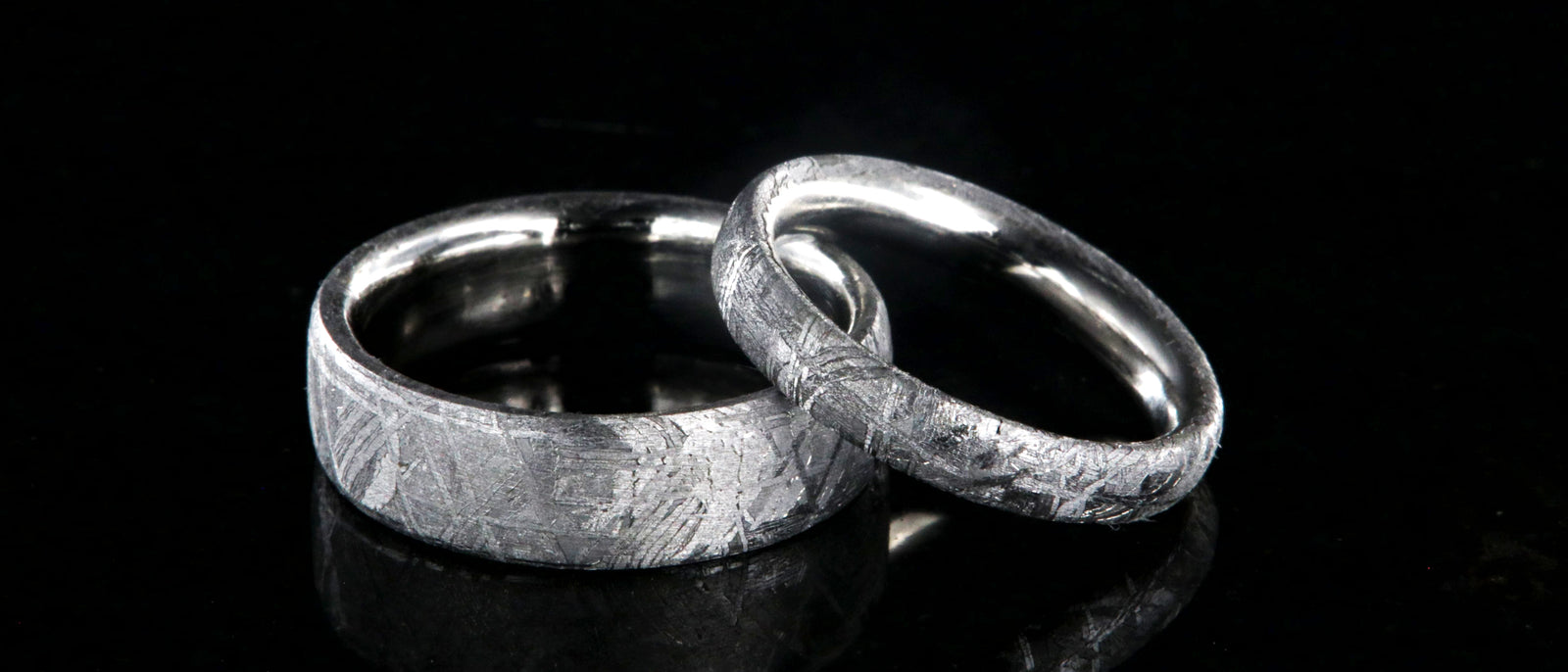
The most reliable visual sign of genuine iron meteorite is the Widmanstätten pattern: a natural crosshatch of crystals that grew as the metal cooled extremely slowly inside that parent asteroid. The pattern is formed of interlocking bands of two iron-nickel minerals, kamacite and taenite. It is not stamped onto the surface, and it is not a print.
When a jeweler makes a light etch on a cut face of the meteorite, that crystal structure becomes visible. Seen up close, a real pattern is irregular. The bands vary in width and length. They have a slight sense of depth in changing light, and no two inlays repeat exactly, because each slice comes from a different place in the original mass. A pattern that looks perfectly even, identical from ring to ring, or completely flat under magnification is a reason to pause and ask more questions.
That uniqueness is part of the pleasure of wearing one. The inlay on your ring will not be a copy of the next.
Ordinary workshop methods do not recreate the way this crystal structure grew in space. What they can do is imitate the look — with a print, an engraving, or a repeated graphic. Close inspection is how you tell the difference: a genuine pattern grows more interesting as you look closer, while a copied pattern usually looks flatter and more regular.
A careful buyer can usually get quite far with four checks.
Ask for the meteorite's name and place of find. Gibeon and Muonionalusta are well-documented irons, recorded in the scientific literature. A named fall is a much stronger starting point than a generic label.
Look at the pattern itself, ideally in person or in large, close photographs. You want that irregular, slightly dimensional crosshatch, not a repeating design. If you ever compare two rings of the same model, the inlays should not be identical.
Remember that iron-nickel meteorite is magnetic. A household magnet will usually be drawn to a genuine inlay. The test is useful in one direction only: if there is no attraction, the piece is unlikely to be iron meteorite. If there is attraction, you have not finished the work, because some steels are magnetic too. Use the magnet together with the pattern and the name, not instead of them.
Ask what documentation comes with the ring. Every Luxurien meteorite ring comes with a certificate of authenticity signed by our shop owner. Before we buy raw Gibeon, it is authenticated by New England Meteoritical Services, a meteorite testing lab in Massachusetts, and we won't purchase meteorite that hasn't been authenticated. A certificate is a statement from the seller, so it is only as meaningful as the work behind it: a named meteorite, a shop that cuts the material itself, and a willingness to answer questions about where it came from.
Namibia now protects meteorites as national heritage, and newly found pieces generally cannot be exported. The Gibeon used in jewelry, including ours, comes from material gathered before those protections took effect. We buy it in solid pieces and cut the inlays in our Utah shop, so the pattern on the ring is the same crystal structure that formed inside that meteorite more than four billion years ago.
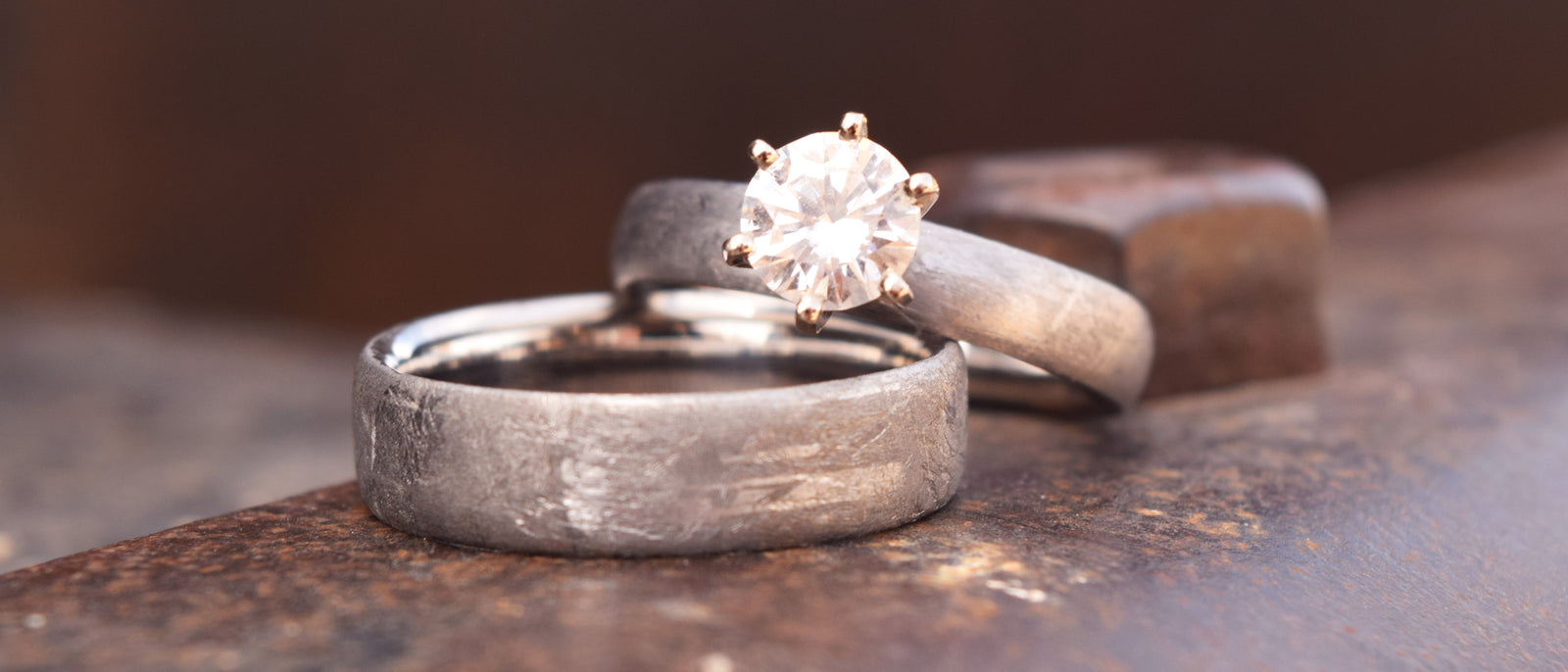
Because we cut the meteorite here, we can set it in a wide range of metals, widths, and profiles — from a classic men's band to a more delicate shape, and from a single ring to a matching pair. Width is a personal choice. Many men gravitate to 6mm or 8mm, which leave enough room for the pattern to be read clearly without overwhelming the hand. Narrower bands suit smaller fingers or a ring worn beside an engagement setting; wider bands make more of a statement.
When we cut meteorite, small remnants are left behind. We collect those shavings and use them in our stardust rings, which have a dark field scattered with genuine meteorite flecks. Couples who want two rings that belong to the same story often start with our meteorite ring sets.

Some designs, such as The Duchess, set Gibeon in an engagement-ring profile.

Customers have left more than 100,000 positive reviews across our stores. We mention that only because it is a fair picture of how long this family shop has been making rings that people actually wear, day after day.
Gibeon is mostly iron, so it can oxidize if it is neglected or left wet. That is uncommon when the ring is worn and cared for, but it is honest to say it can happen. Everyday wear actually helps, because the natural oils on your skin offer a light protectiveness. Take the ring off before pools, hot tubs, the ocean, or harsh chemicals, and pat it dry if it gets wet. If it ever needs a refresh, reach out and we will tell you how to send it in.
Confirm your size carefully before the ring is made, especially on a wider band, which can feel a little snugger than a narrow one. If your size changes later, reach out for details. The right option depends on the metal around the meteorite and on the design, so it is better to talk through your ring than to assume a standard answer.
A meteorite ring is a daily piece, not a display object. Worn with a little care, it is meant to go to work, to dinner, and through the ordinary weather of a life together — carrying, on your hand, a pattern that began before there was an Earth to stand on.
Yes, when they are made honestly. Ours use genuine meteorite inlays, mostly Gibeon, with a handful of designs in Muonionalusta. The crosshatch is the meteorite's own crystal pattern, revealed by a light etch, not a print or an engraving.
Look for a named meteorite, an irregular Widmanstätten pattern that is unique to that inlay, and clear documentation. Magnetic attraction supports an iron-nickel inlay but does not prove it on its own.
Each inlay is a different slice of the meteorite. The crystal pattern changes from one cut to the next, which is a sign of authentic material, not a flaw.
Iron meteorite can oxidize if it is left wet or ignored. Worn daily, kept out of pools and salt water, and dried when needed, a meteorite ring is meant for everyday life. If you ever have a concern, reach out.
A certificate of authenticity signed by our shop owner. The raw Gibeon we purchase is authenticated by New England Meteoritical Services in Massachusetts before we buy it.
It is, if you want a band with a story you can actually trace. Pair the inlay with a metal that suits your hands and your days, confirm your size carefully, and enjoy a pattern that will not be repeated on anyone else's finger.